 Business Tips
Most personal trainers hit the same ceiling sooner or later. Your calendar fills up, your rates are as high as your market will bear, and the only way to earn more seems to be working more hours.
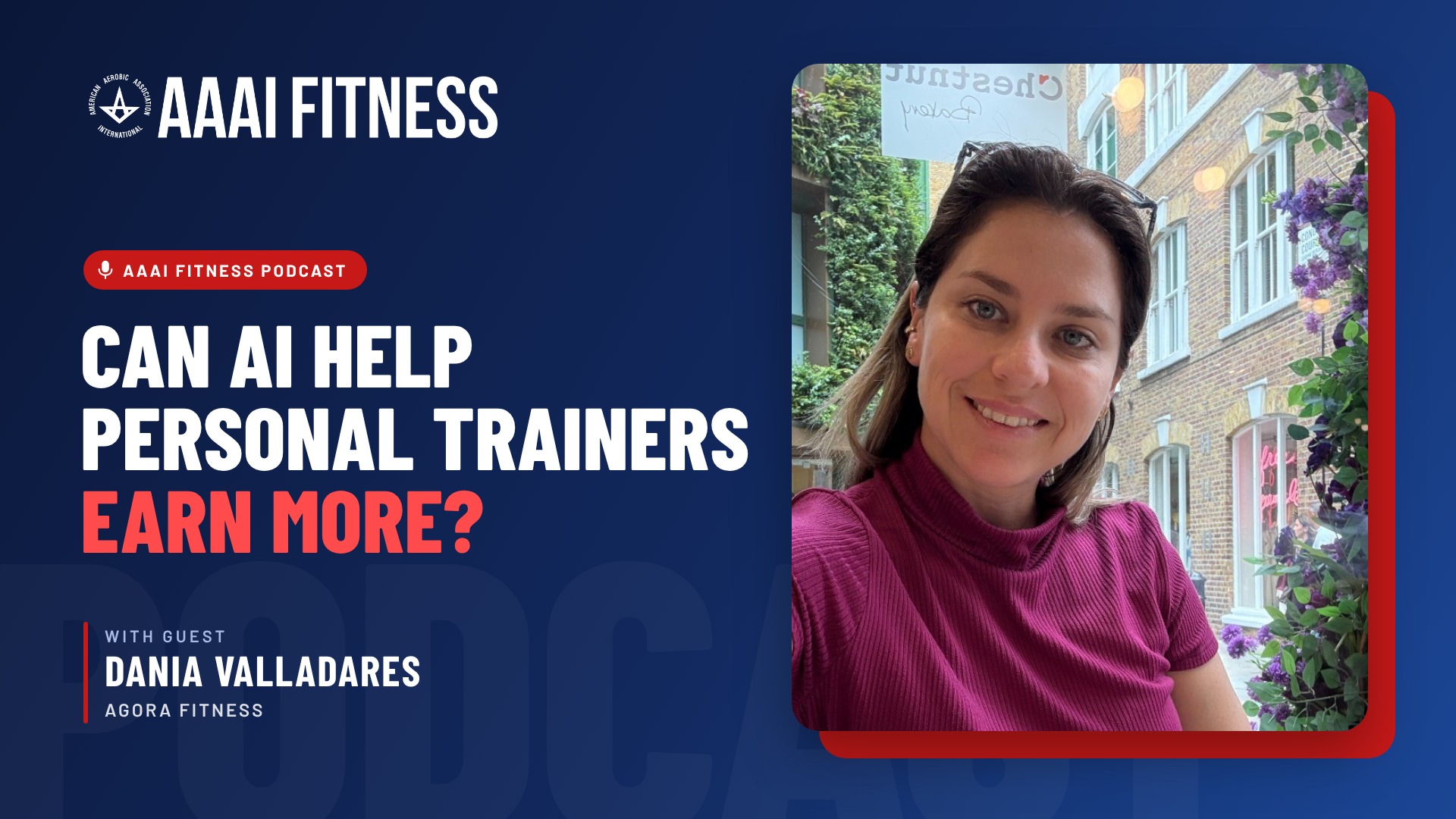
On a recent episode of the AAAI Fitness Podcast, host Joe Cannon, M.S., sat down with Dania Valladares, a software engineer and the founder and CEO of Agora Fitness, to talk about how technology is changing that equation. Agora Fitness lets coaches build AI agents trained on their own methods, systems, and decision-making. Whether or not you ever use an AI platform, their conversation raised three money-making ideas every trainer should be thinking about right now.
Sell Your Method in More Ways Than One
Valladares summed up the traditional trainer business model in one sentence.
“Coaches have traditionally made money either by selling their time or their content.”
Dania Valladares
When the schedule fills up, the usual next step is a PDF program, an ebook, or a library of prerecorded workouts. Those products can bring in extra income, but Valladares points out that they don’t scale well and can’t adapt to a client’s needs in real time.
Your income is capped by the number of hours in your week.
PDFs and video libraries reach more people, but they can’t adjust to the person using them.
An AI agent built on your coaching adds a third option. It delivers programs that follow your rules and adjust to each client day by day. Valladares gave the example of a client who reports only four hours of sleep, which the agent can respond to by easing the session, the same way you would in person.
She also sees untapped income in the audiences many trainers have already built online. By her estimate, most trainers convert well under 1% of their social media followers into paying clients, because those followers have no way to work with a coach whose schedule is full.
- If your schedule were full tomorrow, what would you offer the next person who asked to train with you?
- Which parts of your coaching could work without you in the room?
Turn “I’m Full” Into Your Next Sale
Telling a potential client that you have no openings usually ends the conversation, and that lost sale rarely comes back. Valladares described a different response coaches are using.
“Instead of saying, ‘Hey, I don’t have capacity for this month. Maybe come by next month.’ You can now say, ‘Hey, but in the meantime, you can get a flavor of my method, you can start training with my agent, and ask me if you have any questions.’”
Dania Valladares
Many coaches on the platform use their AI agent as the entry point to their business. A new client starts with the lower-cost digital option and gets a feel for the method. Later, they can add one or two private consultations a month or move into a spot on the trainer’s calendar when one opens.
Language is no longer a barrier either. Valladares shared that a trainer in Latin America uses the platform to coach clients in other languages without paying to translate programs, which opens up an audience well beyond the local gym.
According to Valladares, trainers can launch their first AI agent for free, with unlimited clients, and keep 80% of every subscription they sell. Trainers set their own prices and own the client relationship. Coaches who want several specialized agents, such as separate training and nutrition coaching, can upgrade to a pro membership. Clients use the trainer’s own branded mobile app on iOS and Android.
Treat Your Method Like the Asset It Is
Your expertise is the product you are really selling, and most trainers have never written it down. Setting up an agent on Agora starts with the material you already have, such as client text messages, PDFs, an ebook, or recorded videos.
“You don’t have to come up with your methodology or think about or produce anything new. You just need to bring examples from interactions with your clients.”
Dania Valladares
The platform then asks follow-up questions until it understands how you coach. Valladares said several coaches were surprised to see their own progression models and decision-making laid out plainly for the first time, after years of building programs by instinct.
A documented method also gives you a stronger way to prove that it works. Cannon pointed out that trainers have traditionally relied on an “N of one,” training one or two people for free in exchange for before-and-after photos. Results gathered from a hundred or more clients following the same method make a far more convincing case on your website and in sales conversations.
Your coaching method is a business asset. Document it, protect it, and put it to work.
Valladares said protecting that asset is a top priority for the platform. An agent delivers workouts and plans without revealing the trainer’s underlying system, and one trainer’s material is never used to train another trainer’s agent.
- Write down how you progress a new client through their first eight weeks.
- Collect the coaching cues and phrases you use most often.
- Track the same few results for every client so you can share real numbers.
Before You Hand Your Method to an AI
Cannon asked the questions every responsible trainer should ask before putting their name on an AI product. Valladares described three levels of safety checks. The first is the coach’s own rules, such as the populations they do not train. The second is a set of platform safety standards drawn from published research and fitness advisors. The third comes from the AI models themselves.
- Questions outside the trainer’s expertise, such as a client asking for diabetes advice, are meant to be declined and redirected.
- Trainers can see each client’s program and workout tracking, while the client’s chats with the agent stay private.
- Clients accept terms of service that release the coach and the platform from responsibility, because they know they are working with an AI.
Check your liability insurance and your certification’s scope-of-practice guidelines before offering any AI-delivered coaching, especially nutrition guidance.
Adapt Without Losing the Human Touch
Cannon closed with the question many trainers are quietly asking, which is whether AI will replace them. Valladares does not think so, with one important caveat.
“I think AI would replace as a technology anyone who fundamentally doesn’t adapt for the future with this technology.”
Dania Valladares
She believes what keeps trainers valuable is what engineers call “taste,” the judgment shaped by your own experiences that no general-purpose fitness app can copy. Generic AI apps can write a workout, but they cannot coach the way you do.
The trainers who earn more in the next few years will be the ones who find new ways to deliver the coaching only they can give.
Watch the Full Episode
Hear Joe Cannon and Dania Valladares talk through AI agents, pricing, privacy, guardrails, and the future of personal training. To explore the platform, visit agora.fitness and choose Join as Trainers.
Build the Expertise Worth Scaling
Your method is only as valuable as the knowledge behind it. Explore AAAI Fitness certifications and continuing education to strengthen your coaching and grow your career.
See Upcoming Certifications